
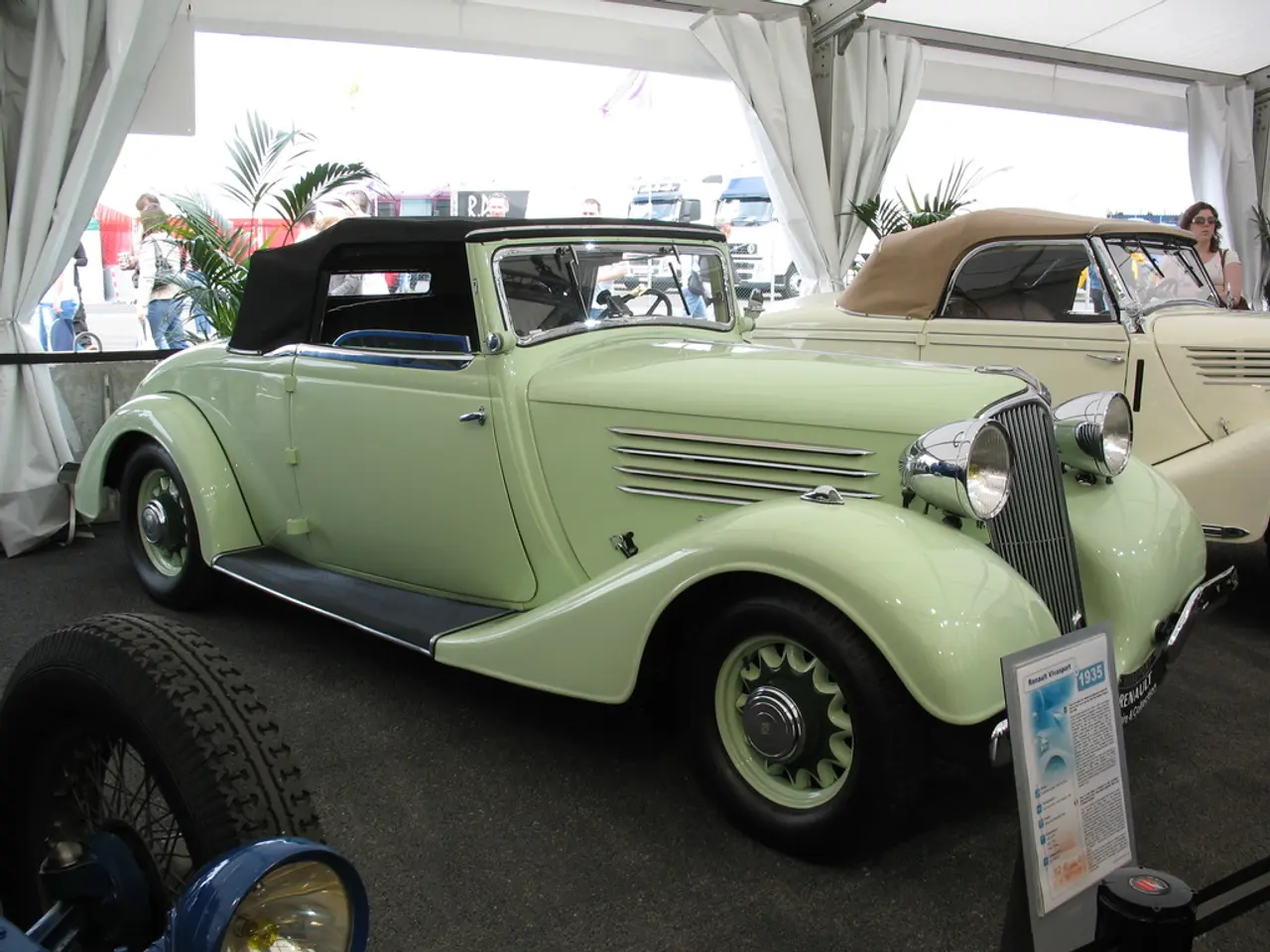
Revival of historic city ambience through classic car enthusiasts' efforts
Reviving Urban Memory: The Classic Car Movement in Ho Chi Minh City
Ho Chi Minh City, a bustling metropolis with a rich history, has seen a resurgence of classic cars on its streets. This revival, known as the classic car movement, dates back to the late 1990s when individual enthusiasts began collecting and restoring vintage vehicles.
For decades, many classic cars had disappeared due to post-war hardships, economic restructuring, and the impracticality of maintaining gas-guzzling American "muscle" cars and older models from the 1940s-1960s. Many iconic public vehicles such as Renault taxis, Peugeot cars, and Simca cars were phased out, leaving a gap in the city's automotive heritage.
The initial preservation efforts were isolated and informal, with collectors hiding forgotten vehicles in their homes. However, from the late 20th century, these independent efforts gradually grew into a recognizable classic car scene. This transformation was marked by the formation of enthusiasts’ groups and the re-establishment of restoration garages.
One such group is the Saigon Classic Car Club, which fosters a community around vintage car collecting and traveling with restored vehicles. Members like Tran Khack Duong use their classic cars as their daily mode of transport, showcasing their commitment to preserving this aspect of Vietnam’s urban memory.
Another club, the Saigon Beetle Club, is dedicated to preserving and celebrating Volkswagen's iconic Beetle. The Vice President of the club, Tran Van Lam, views the Beetle as a lovable, simple, easy-to-fix, and incredibly durable vehicle. Members often gather for social events and discussions about their cars.
Nguyen Van Nhohn commutes between HCM City and Binh Duong in a 1970s Continental and a 1960s Mercedes W111, while Nguyen Thanh Binh has stuck with his 1984 Land Cruiser BJ40 for two decades. These individuals are just a few examples of the passion and dedication that drives the classic car movement in the city.
The challenge of finding original parts for vintage cars was highlighted by Trần Văn Tuấn, a member of the Saigon Classic Car Club's management board. He recalled the difficulty of finding original Citroën Traction Avant parts. However, proper maintenance ensures that vintage cars remain reliable and durable, as demonstrated by users like Tran Khack Duong and others.
Classic cars are increasingly being used in period film sets to maintain historical accuracy. This use not only showcases the beauty of these vintage vehicles but also contributes to the preservation of their history.
The decline of vintage cars continued into the 1980s and 1990s, with many rare vintage cars in Vietnam being deregistered and exported overseas. However, the classic car scene in HCM City has continued to evolve and thrive, with valuable vintage car collections owned by individuals such as Dang Le Nguyen Vu of Trung Nguyen Coffee, Nguyen Xuan Thuy, Tran Van Lam, and others.
Vintage vehicles from France, the UK, Germany, Italy, the US, Japan, and more are treasured by Saigonese collectors. Today, classic car enthusiasts treat their vehicles as companions on vibrant adventures across Vietnam and beyond.
In conclusion, the classic car movement in Ho Chi Minh City is a testament to the city's resilience and its people's passion for preserving their urban history. The movement not only enriches the cityscape with nostalgic beauty but also serves as a reminder of the city's past and its evolution over time.
[1] This article is based on the provided bullet points and does not include any additional research.
- Despite the economic hardships and practicality issues, the government is now actively promoting the classic car movement in Ho Chi Minh City to preserve its automotive heritage.
- The travel industry is benefiting from the classic car movement, with tours organized for international tourists who want to experience the history and lifestyle of the era.
- The use of AI in restoring vintage cars is helping to maintain their originality and durability, making it easier for enthusiasts to preserve their fashion-and-beauty relics.
- War veterans are showing their respect and gratitude by restoring and maintaining classic cars that were popular during their service, providing a unique connection to their past.
- The food-and-drink scene in Ho Chi Minh City is embracing the classic car movement, with themed restaurants and events featuring the unique charm and ambiance of vintage vehicles.
- With the rise of classic cars, the home-and-garden sector is also witnessing a surge in demand for vintage-style furniture, décor, and accessories to complement these nostalgic rides.
In the realm of casinos and gambling, the understanding is that the high-rollers might find luxury classic cars as an attractive prize for their games, while in the realm of sports and sports-betting, the classic car movement could potentially host vintage car races or use classic cars as incentives for fan engagement. However, these connections are speculative and not directly stated in the text.




